
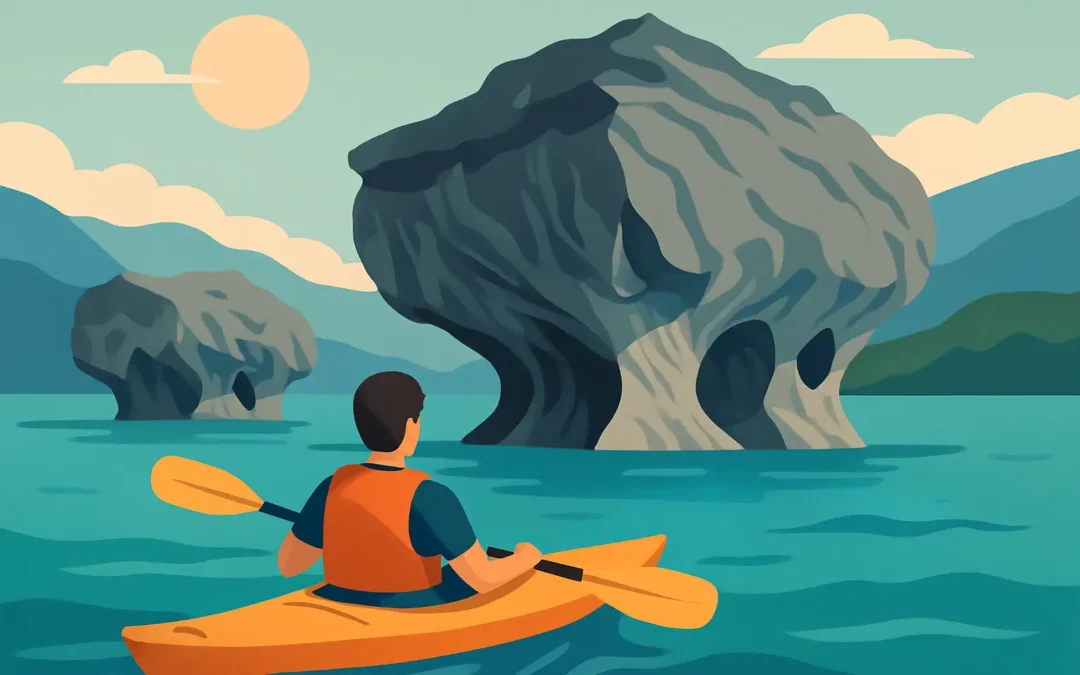
There is a moment in General Carrera Lake when silence outweighs the paddle. You approach a wall of marble polished by thousands of years, the water changes from blue to turquoise, and suddenly you are inside a cavern where the light bounces as if someone had turned on a spotlight under the lake. That's what makes a full day cathedral and marble chapel by kayak special: you don't look at it from the outside, you go through it with your body, at a human pace, without motor noise.
Why kayaking (and why a full day)?
Seeing the Marble Chapels from a boat is nice. Doing it by kayak is another league. In the kayak you go lower, closer, slower. You can stand still for a minute and listen to how the rock drips, how the water moves inside a vault, how the color changes when a cloud covers the sun. That closeness is the difference between “visiting” and “living” the marble.
The full day format is perfect if you are in Coyhaique or moving along the Carretera Austral with only a few days to spare. In one day you get the Aysén icon Well done: a resolute transfer, a large window for paddling and for waiting for the best moment of light, and the peace of mind of not running. In addition, the lake is large and temperamental. Having a time margin allows you to adjust the start if the wind becomes demanding.
What you will actually see: Cathedral, Chapel and the marble inside.
The Marble Cathedral impresses by volume. It is that structure that looks like a carved nave, with columns and soft ceilings, as if the lake had sculpted a stone church. The Chapel is more intimate: narrow passages, curves, small chambers where light streams in diagonally. On a good day, the marble is streaked with white, gray and a faint blue that looks painted.
What many photos don't capture is movement. The color changes by the minute. In sunshine, the water becomes almost transparent and the marble reflects blue-green tones. With overcast skies, it becomes more dramatic, more metallic. In kayaking, those changes accompany you and are felt on your skin: the cold air coming out of a cave, the soft echo as you enter, the friction of the paddle in calm water.
What is a typical full day from Coyhaique like?
Most travelers use Coyhaique as a base, and it makes sense: you are well connected and can leave early without improvising. A full day usually starts with pick up and transfer by the Carretera Austral to the surroundings of Puerto Rio Tranquilo. The road is already part of the trip: forests, rivers, mountains and that feeling of being away from the urban to enter the rawest Patagonia.
Upon arrival, a brief safety and technical briefing is given. You don't need to be an expert, but you do need to be willing to move and listen. We adjust the equipment, review how to get in and out of the kayak, how to stay on course, and what to do if the lake changes. Then comes the navigation: an approach section and a detailed visit to the formations, entering and exiting caves depending on the water conditions.
In the middle of the day there is usually a break to eat, hydrate and recover heat. It is an excursion that is more enjoyable if you are not short of energy. Then you paddle back calmly, pick up your gear and head back to Coyhaique with that rare mix of happy tiredness and a blank mind.
Real difficulty: who it is for and who it is not for
This tour is intended for active people, not athletes. If you can walk for a couple of hours, keep moving and tolerate moderate cold, you are usually fine. Paddling for several hours at a time is tiring, especially shoulders and back, but with technique and breaks it is totally bearable.
Now, the important “depends” is the wind. Lake General Carrera can get rough and, if it blows hard, the demand increases. A responsible operator will adjust the route, change schedules or even reschedule if safety requires it. If you get seasick easily, if you have shoulder/back injuries or if you panic in open water, it is a good idea to talk about it beforehand and consider alternatives.
What to wear: the secret is layered warmth
In Aysén the weather does not negotiate. Even if the morning is clear, the water is cold and the wind appears without warning. The key is to dress in layers and avoid cotton.
A thermal first layer keeps you dry. On top, a fleece or midlayer that keeps you warm without weighing you down. And on the outside, a waterproof jacket or windbreaker to cut the lake breeze. Thin gloves help keep your hands sensitive. A light hat and sunglasses make a difference when the light bounces off the water.
It's also a good idea to bring a dry change of clothes for the return trip. Not that you're going to tip over, but splashes and wetness are part of the game. And if the tour includes technical equipment, your clothing still defines your comfort.
Safety and ecotourism: responsible adventure, not posturing
Paddling inside marble caves is exciting precisely because it is a living place. The water level changes, there are gentle swells in and out, and some entrances become narrow depending on the condition. That's why the guide's judgment matters as much as the scenery.
In a well-managed outing, you navigate with distance between kayaks, avoid abrupt maneuvers in caves and choose safe accesses. The objective is not to “get in anywhere” for the photo, but to get to know the place without damaging it and without putting yourself at risk.
Ecotourism here is noticeable in details: minimize noise, don't touch the marble, leave no debris, and respect other boaters. It seems obvious, but in such an iconic destination, getting it right is what keeps the experience intact.
The best season and the best time: light, water and wind.
Summer and early fall are usually the favorite months for temperature and daylight hours, but that doesn't mean that the rest of the year is impossible. What changes is the margin: in colder months you need better clothing and more tolerance to variable conditions.
Time also counts. In lower light, the marble looks different, more textured. With high sun, the color of the water intensifies and the caves are illuminated in an almost unreal way. The wind usually picks up at certain times of the day, so a full day itinerary with local equipment has the advantage of playing with that window and finding the best time to enter the formations.
Boat or kayak? The honest choice
If your priority is to see the marble with the minimum physical effort, the boat complies. You arrive quickly, get close, take pictures, go back. For families with very small children or people with reduced mobility, it may be the most sensible option.
If what you are looking for is to feel the place, kayaking wins. It demands you, gets you inside, forces you to slow down. There is more contact with the water and a greater sense of expedition. The trade-off is clear: kayaking depends more on the weather and demands more energy. That's exactly why, when it goes well, it sticks.
Hassle-free booking: what you need to be clear on
On the Carretera Austral, improvising sometimes costs a lot of money: quotas that run out, limited schedules and weather that forces you to move parts. If your trip has closed dates, book in advance and leave some flexibility in your planning in case you have to adjust for wind.
If you want to do it with an operator specialized in star routes in Aysén and with a clear online booking, you can check the full day at Patagonia Xtreme. The beauty of this type of format is that you get the logistics out of the way and stay with what's important: paddling in one of the wildest landscapes in the south.
Quick questions that often come up before you go
Do I need previous kayaking experience?
No. It helps to have paddled a few times, but it is normal for the guide to teach basic technique and manage the pace of the group.
Am I going to get wet?
A little, yes. Between splashes and ambient humidity, count on ending up partially wet. Being well-dressed changes everything.
Is it possible to enter the caves?
It depends on the condition of the lake and the level of the group. When it is safe, you visit inside and explore corridors and chambers.
What happens if there is a lot of wind?
The route is adjusted, the schedule is changed or rescheduled. At the General Carrera, security is in charge.
Approach the marble as it deserves: unhurriedly, with the sound of the paddle and the view at water level. And when you get back on the road, don't be surprised if the rest of the trip seems a little quieter. Sometimes Patagonia changes your internal volume, and that's also part of the adventure.
 English
  Español