
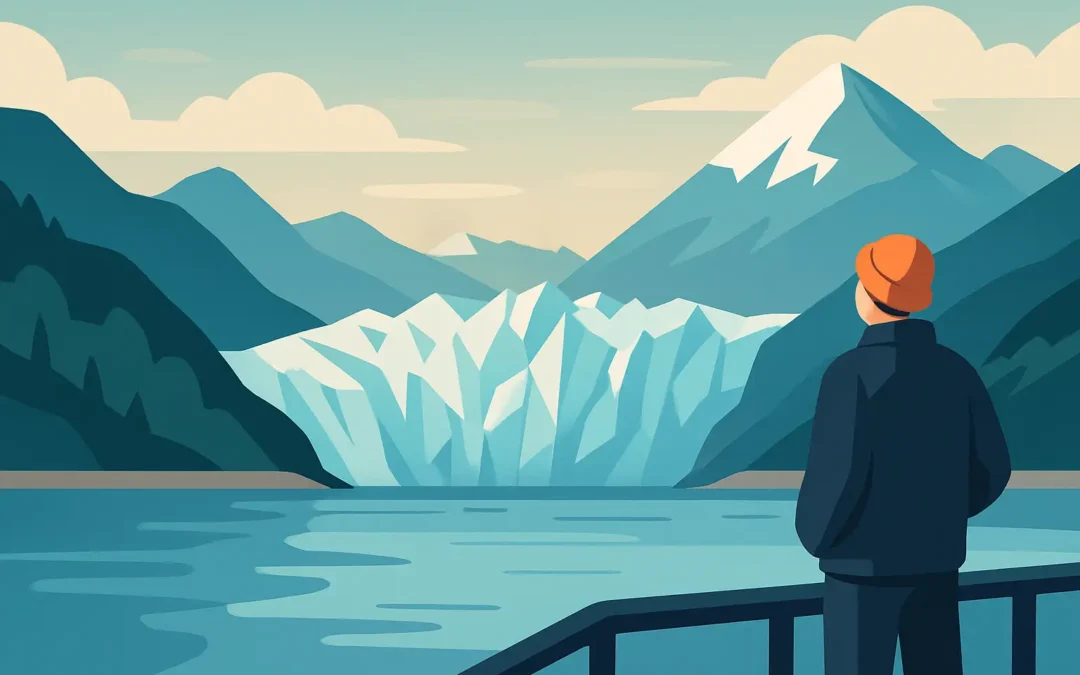
There is a very southern moment in Aysén: the engine slows down, the air gets colder and, suddenly, ice appears. It is not a distant postcard. It is a living wall, bluish, that creaks, drips and sometimes breaks with a roar that leaves you in silence. If you are coming along the Carretera Austral and are using Coyhaique as a base, this guide is designed so that the glacier is not “just another photo”, but a well done experience, safe and with that feeling of being in nature in its purest state.
Guide to glaciers in the Aysén Region: the essentials before making your choice
In Aysén there is no single “glacier”. There are different ways to see millenary ice and each one requires different logistics. The key is to decide what kind of day you want: long navigation and glacier protagonist, short hike with powerful viewpoints, or a mix with rainforest and waterfalls.
It also pays to be honest with your travel style. If you are attracted to the ice but do not want to improvise roads, times or tides, the most comfortable is to go with a guided excursion. If you prefer to go at your own pace, you need margin for changes due to weather, gravel roads and barge schedules or local navigation. In Aysén, “it depends” rules, and that is part of its magic.
The unmissable glaciers (and how to experience them)
Laguna San Rafael: the great ice stage
If you dream of icebergs floating in gray-green water and a glacier front that imposes itself, Laguna San Rafael is usually the name that changes everything. Here the protagonist is the San Rafael Glacier, one of the most accessible of the Northern Ice Field in excursion format.
The experience is one of navigation and close contemplation. It is not a trekking on ice for beginners, but an encounter with the glacier from the water, with the sound of the ice working. Sometimes there are small detachments, sometimes the spectacle is more subtle, but there is always that feeling of being in front of something ancient and moving.
What you should know: it is a long trip, usually a full day, where the weather rules. You can have open skies and, an hour later, horizontal rain. If you get seasick by boat, be prepared in advance. And assume that the distance is part of the prize: getting there is already an adventure.
Queulat National Park: Hanging snowdrift and humid forest
Queulat is not “just a glacier”. It is temperate rainforest, rivers of icy water and a natural amphitheater where the Hanging Glacier falls from above. Here the glacier is seen from viewpoints, and the road gets you right into that intense green that makes the ice stand out even more.
Queulat's charm is that it combines well with travelers who want to hike without the need to be experts. There are trails that take you to panoramic points with very photogenic views. Of course, the trail can be slippery and wet even in summer, so footwear makes a difference.
What you should know: the “overhang” is part of what makes it unique. You won't always see big ice slides, but the whole landscape is the show. And, if the day is closed, the forest is still an experience in its own right.
Northern Ice Field: the idea behind many dreams
Although most travelers know specific names (San Rafael, Exploradores, etc.), understanding that Aysén coexists with the Northern Ice Field helps to put everything in context. You are traveling near one of the largest ice reservoirs on the planet outside of the polar areas.
This does not mean that everything is simply accessible. Many accesses require permits, guides and adequate conditions. It is a territory that rewards planning and respect for the mountain.
When to go to see glaciers in Aysén?
The best season is usually between spring and early autumn, when there are more daylight hours and the logistics are friendlier. Even so, in Aysén the weather does not “behave well” just because it is summer. It can rain, it can be sunny, it can be windy. The point is to go prepared and with realistic expectations.
If you are looking for a more comfortable sailing and road experience, the more stable months tend to attract more people. If you prefer less crowds, you can aim for shoulder months, assuming more likelihood of rain and changes.
How to choose your excursion according to your style (without making a mistake)
If your priority is to see ice up close with a feeling of immensity, sailing to San Rafael Lagoon is the classic. If you want a day of moderate hiking, intense green and a postcard hanging glacier, Queulat is a safe bet.
Then there is the time factor. If you are only in Coyhaique for a few days, it is best to choose a single large glacier trip and not try to “fit it all in”. The Carretera Austral is not traveled in a hurry, and forcing itineraries usually results in fatigue and little enjoyment.
Your tolerance for uncertainty is also important. If you are frustrated that a viewpoint is covered by clouds or that a navigation changes due to wind, you may want a guided tour that optimizes routes and alternatives. If you live it as part of the adventure, you will love Aysén.
What to bring for a glacier day (and why it matters)
In an icy and cold water environment, comfort is safety. Layered clothing works because it allows you to adapt to sudden changes: warmth when walking, cold when stopping, wind on deck.
Take a real waterproof jacket, fleece or thermal layer, and a windbreaker if you have one. Thin gloves help more than it seems, especially in navigation. The ideal footwear is with good soles, because between mud, wet roots and wet walkways, slipping is the silent enemy.
If you are going to take pictures, protect your equipment. Rain appears without asking permission. And don't underestimate the sun: when it opens up, the reflection on ice and water can be strong.
Safety and conservation: responsible adventure shows
Glaciers are not a theme park. They are dynamic, cold and sometimes unpredictable environments. Keep your distance from edges and marked areas, stay on trails, and listen to guides and park rangers. This respect is what allows more travelers to experience the same without leaving a trace.
In Aysén, the outdoor ethic is simple: take away garbage, avoid feeding wildlife, and understand that a good trip is not the one that “imposes itself” on the place, but the one that adapts to it.
Going on your own or with a guide? Depends on your trip
Going on your own gives you flexibility and the pleasure of deciding as you go, but demands time, a vehicle suitable for gravel roads, tolerance to delays and the ability to react to changing weather. With a guide, you gain in peace of mind, interpretation of the place and resolved logistics, especially in long routes where details matter.
If you want a direct option with online booking and closed full day excursions to the icons of Aysén, you can look at the exits of Patagonia Xtreme from Coyhaique. The trick is to go for the concrete: clear itinerary, local guide and less friction so that your energy goes into enjoying yourself.
What most people don't tell you: the glacier is also the road.
The glacier experience in Aysén does not begin when the ice appears. It starts on the road, in the soaked forests, in the color of the rivers, in that feeling of being far away from everything. If you understand it this way, even a cloudy day becomes valuable.
And there is a simple truth: you don't control Patagonia, you just negotiate with it. When you accept that, the expectation changes and the trip gets better.
Close the day with the same logic with which you entered: calmly, with respect and with the joy of having seen something real, without filters. If the ice gave you a crunch or a flash of blue between clouds, keep it as you keep the best things of the south: without haste and eager to return.
 English
  Español