
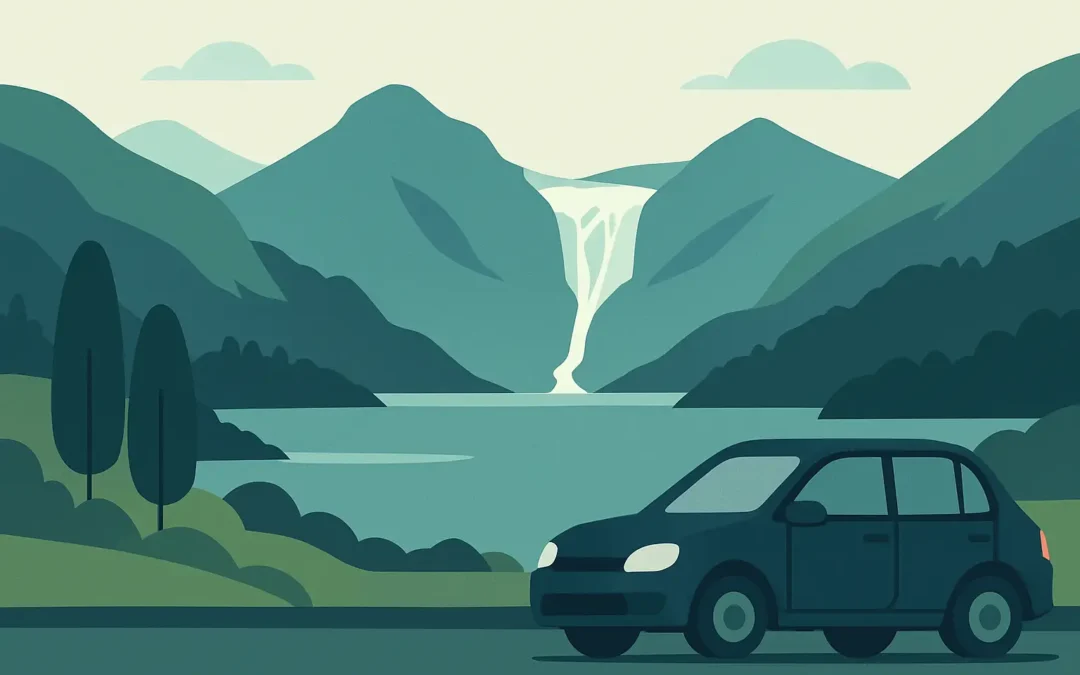
There is a very specific moment on the Carretera Austral when the landscape changes tone. You leave the more open valley of Coyhaique, enter the humid forests and, almost without warning, the green becomes bright green and the air smells of clean rain. If you are considering an excursion queulat park from coyhaique, This change is part of the fun: it is not just “reaching the glacier”, it is feeling how Patagonia becomes more untamed kilometer by kilometer.
Queulat Park Excursion from Coyhaique: what really awaits you
Queulat is not a park to “pass over”. It is a place to be enjoyed with rhythm and attentive eyes: Valdivian rainforest, waterfalls that appear from the road, hanging bridges and, as the main protagonist, the Ventisquero Colgante (hanging snowdrift). The most common tour from Coyhaique is a full day tour, because the distance is considerable and because the weather rules. In the same day you can move around with logistics solved, walk the key trails and return with the feeling of having touched a real icon of Aysén.
The experience usually combines three ingredients that work: scenic road, guided hike and time for leisurely contemplation. You don't need to be an athlete, but you do need to come willing to walk and get a little wet if the south decides to remind you who's boss.
Distance, times and route: the “mental map” of the day
From Coyhaique the trip is long, and that is not a disadvantage. The route itself is a spectacle, with curves that open up natural viewpoints and stretches that take you into a forest tunnel. As a realistic reference, count on several hours of travel time each way, plus stops and trail time.
The smart thing to do is to assume the day as a complete journey: early departure, road with brief stops for photos and stretching your legs, park entrance, main trek and return. In high season, timing matters, because the park and trails are much more enjoyable when you are not running.
Here there is an important “it depends”: in Aysén the weather can change the rhythm. If there is heavy rain, the forest becomes even more beautiful, but the trails require more care. If there is a clearing, the snowdrift shines and the viewpoint becomes that place where you stay quiet without realizing it.
The Hanging Glacier: the postcard that moves
The first time you see it you understand why Queulat is a must-see. It is not a static glacier: it hangs between mountains, feeds a waterfall and creates a moving landscape. The sound of the water and the contrast between ice, rock and rainforest has something hypnotic about it.
Trekking to the lookout point: medium effort, high reward
The trail to the Ventisquero Colgante viewpoint is the star of the day. It is not usually technically difficult, but it does require perseverance: there is a climb, stretches with roots and mud depending on the season, and natural stairs where it is advisable to go with a firm step. The key is not to “get there fast”, but to maintain a comfortable pace to enjoy the forest.
If you travel with a local guide, the difference is noticeable: he sets the pace, helps you read the terrain when it's slippery, and tells you what you're looking at, from the type of forest to how that seemingly impossible hanging ice is formed.
The footbridge and the lake: another view of the park
In addition to the classic viewpoint, Queulat has areas of walkways and views of the lake where the landscape becomes softer, perfect for photos and breathing. On misty days, the water looks dark and deep; with sunshine, green reflections and an almost tropical glow appear, but with a Patagonian temperature.
When is the best time to go? Season, weather and expectations
Queulat can be visited in different months, but the experience changes. In spring and summer you have more daylight hours and, in general, better accessibility for long walks. Even so, rain is part of the character of the place and should not catch you by surprise.
In autumn the color of the forest becomes more dramatic and there are fewer people, although the weather can be more unstable. In winter, depending on conditions and routes, the logistics become more demanding and it is not always the most comfortable option for a full day, especially if you are looking for uncomplicated trails.
The practical recommendation: choose date by availability, but choose equipment by reality. In Queulat, being well prepared is worth more than chasing the “perfect day”.
What to wear to enjoy (without suffering)
You don't have to come with technical gear, but you do have to come with Patagonia's criteria. If you could only get three things right, they would be: waterproof clothing, trekking shoes with good soles, and a warm layer that will work even when you stop at the lookout point.
From there, add what will make your day more comfortable: a small backpack, water, some snack food, thin gloves if you are cold and sunscreen, because the clear skies of the south are deceiving. And a simple tip that avoids dramas: wear appropriate socks. Mud and humidity do not forgive cotton.
For free or with tour? What you earn and what you give up
Doing the tour on your own gives you the flexibility to stop wherever you want and adjust times to suit your style. In exchange, you eat the long drive, the planning of the day, the schedule control and the uncertainty if the weather gets tight or if you lack context of the park.
With a full day tour, the value is in the logistics and peace of mind: transportation, timing, entrance and accompaniment. In a destination where the weather changes and the road demands attention, going with a professional local guide is not a luxury, it is a way to travel more safely and with more focus on what is important: walking, watching and enjoying.
If you want to make it easy and straightforward, in Patagonia Xtreme we work the full day trip to Queulat from Coyhaique as a closed product, designed for you to book online without any hassle and dedicate yourself to live the route.
How to live a typical full day (without promising a rigid script)
In this type of excursion, the day usually starts early in Coyhaique. The first part is road and occasional stops for photos, coffee or just to stretch your legs with the forest beside you. When you reach Queulat National Park, the focus shifts to the trails: there the experience becomes quieter, more sensory.
The trek to the viewpoint becomes the high point of the day. You walk, climb, cross wet stretches, and suddenly the snowdrift with its waterfall appears. That time at the viewpoint is worth all the effort. Afterwards, the return trip feels different: the body tired, the head full and the road back as a stretch to process what you have experienced.
What changes from day to day is the rhythm and the light. Sometimes the glacier is clear. Other times, it hides behind low clouds and gives you a more mysterious scene. Queulat does not always give the same photo, but it almost always gives the same emotion.
Small decisions that greatly enhance the experience
If your idea is to take pictures, think about rain protection. Water not only gets wet, it also fogs up lenses and makes you lose moments. If you are interested in walking calmly, consider choosing a weekday or going out at a time that avoids peaks. And if you are traveling as a couple or with friends, agree beforehand on the style: there are those who want to walk hard and those who want to stop at every corner. In Queulat, both ways are valid, but it is good to know.
It also helps to understand that the hike is long. It is not a short walk from Coyhaique. It is a full day of real Patagonia, and that is most appreciated when you assume it from the beginning: get up early, move, walk, come back.
Perceived price: why this output feels “southern highway”.”
There are tours that are paid per activity and others that are paid for what they make you feel. Queulat falls into the second group. You get a national park with a personality of its own, a hanging glacier that doesn't seem possible and one of the most mythical roads in the south as a common thread.
And there is a detail that many travelers do not expect: the forest. People usually come for the ice, but they are left with the rainforest, with that feeling of being inside a living landscape.
If at the end of the day you return to Coyhaique with mud on your boots and the smell of rain on your jacket, it's a good sign. It means you didn't go to “see something”, you went to be there.
Patagonia cannot be tamed, but it does allow you to get to know it at a steady pace. And Queulat, when you visit it with time and respect, gives you back exactly that: an untamed beauty that stays with you more than any photo.
 English
  Español