
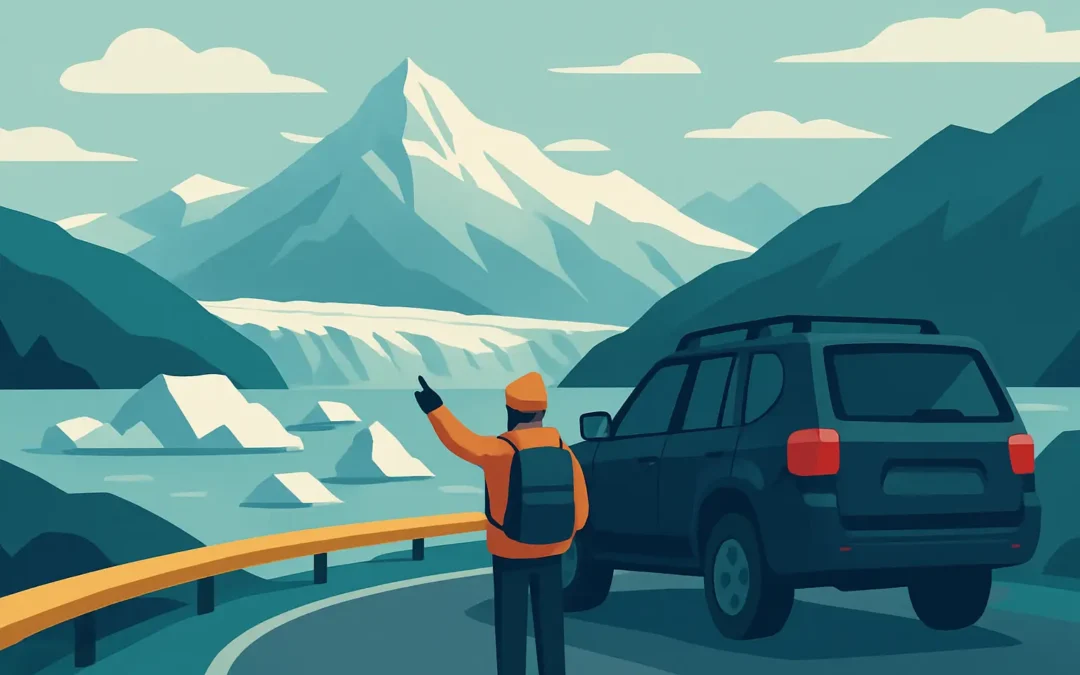
There is a very southern moment on this route: you drive along the Carretera Austral with the forest sticking to your windshield, the smell of cold rain and, suddenly, you understand that the destination is not “a glacier”. It is the exact point where Patagonia ceases to be a landscape and becomes an experience: fjord-colored water, living ice walls and a silence that is only broken by landslides.
If you are thinking about a excursion to San Rafael Glacier from the Carretera Austral, here's what really matters to get it right: where to enter, what options make sense based on your time and type of trip, and how to prepare for an epic day - not a race against the clock.
San Rafael Glacier Excursion from Carretera Austral: the basics
San Rafael is not a viewpoint that you just drive to. It is a complete system: roads that end, stretches of lake, navigation, and a climate that rules. That's part of its magic, but also why it pays to plan ahead.
Most travelers who travel through Aysén move between Coyhaique, Puerto Río Tranquilo, Puyuhuapi and Puerto Aysén. From this backbone, the excursion can be put together in two main ways: as an organized trip with closed logistics (the most common if you want to ensure space and time) or as a more self-managed trip, assuming coordination of transfers and weather windows.
Here the “it depends” is real: it depends on your schedule, whether you travel by car or bus, your tolerance for changes of plan, and whether you want to add outdoor activities (such as kayaking) or focus on sailing and ice contemplation.
From where is it convenient to take the Carretera Austral?
The most comfortable base for many travelers is Coyhaique, because it concentrates services, lodging and connectivity, and allows you to chain other must-see places in Aysén without improvising every day. If you are already in the northern axis (Puyuhuapi, La Junta), you can also consider it closer, but keep in mind that “close” in Patagonia means something else: long distances, curves, gravel in sections and schedules that do not always adapt to what one imagines.
From Coyhaique, the departure usually involves road transfer to the embarkation point (depending on the format of the tour), and from there navigation to the lagoon and the glacier front. If you are doing the Carretera Austral en route to the south, you can try to fit the day of San Rafael as a key part of the itinerary, leaving margin before and after. In Aysén, a cushion of time is worth gold.
Two ways to experience San Rafael: sailing or active adventure
The San Rafael Glacier can be “seen” in several ways, but the sensation changes a lot depending on the approach.
The most classic experience is the navigation that takes you close to the ice front to observe ice slides, floating icebergs and the brutal scale of the glacier. It's the kind of day that impresses even if you've seen glaciers before, because here the ice blends with the water in a scene that looks like it's from another planet.
The second way, if you are looking for a more outdoor point, is to combine the visit with water activities. Kayaking, when conditions permit, gets you into the landscape with a different intensity: you are no longer “looking” at the glacier, you are inside the fjord, reading the wind, listening to the cracking of the ice. You don't need to be an expert, but you do need to come with attitude: getting wet is part of the deal.
The trade-off is clear. Pure sailing tends to be more predictable in timing and more suitable for all types of travelers. The active option depends more on the weather and requires more energy and appropriate clothing, but in exchange you get a more direct connection with the environment.
Actual times: how long a day's excursion usually takes
On the Carretera Austral, the days are longer. A full day to San Rafael is not “a few hours”: it is a full day, leaving early and returning at low light, depending on the season.
Most of the time is spent in three blocks: road transfer, navigation and operational windows (embarkation, disembarkation, briefing, safety times). That's good: it's not a rushed excursion, it's a crossing.
If you are fitting it into a longer route (e.g., Marble + Queulat + San Rafael), the smartest thing to do is not to schedule another main course for the same evening. You can have dinner, take a walk, rest and let the body slow down. The next day you will enjoy it more.
Weather in San Rafael: untamed beauty with rules of its own
If there is something that defines San Rafael, besides the ice, it is the changeable weather. Thin rain, fog, wind that rises without warning. This instability does not ruin the experience, it makes it authentic, but it requires preparation.
On clear days, the colors explode: impossible turquoise in the water, white and blue in the ice, saturated green in the forest. On gray days, the glacier becomes dramatic, almost cinematic. The difference is not “better or worse”, it's “which version of Patagonia you get”.
Of course, wind and visibility can affect navigation or activities on the water. That is why, when you book a serious excursion, there are safety criteria and decisions that are not negotiable. In this type of place, responsible adventure is evident in the details.
What to wear so as not to suffer (and to enjoy more)
You don't need technical expedition gear, but you do need to dress strategically. The typical mistake is to come with a nice jacket and urban sneakers. Here, humidity, cold and the real possibility of getting soaked rule.
Think in layers: quick-drying first layer, mid-layer and waterproof outer layer. A thin hat and gloves make a difference when you are standing on the glacier, because the body cools quickly in windy conditions.
On the feet, closed shoes with good soles. If it rains, the terrain and walkways become slippery. And put in a dry or protected bag what you don't want to lose: cell phone, documentation, an extra layer.
Camera or no camera, you're going to want to record something. Just remember that cold and wet weather eats batteries: carry extra power and don't trust everything to a single device.
Booking with an organized tour vs. going it alone
Going it alone sounds romantic, and sometimes it fits if you have experience in the area, a vehicle, flexibility and patience to coordinate. The B side is that San Rafael works with windows, quotas and logistics. If your trip is a vacation with a limited number of days, the most common is to prefer an operator that delivers a closed product: transfers, navigation and guide.
What you buy on a tour is not just transportation. You buy operational peace of mind, timings designed to get you where you need to be, and someone to read the weather and make decisions on the ground. For the average traveler - active, adventure-seeking but not wanting to figure it all out - it's usually the most rounded option.
If you feel like doing it with an experience designed for Carretera Austral travelers and with a simple online booking, at Patagonia Xtreme you have structured excursions through the classics of Aysén, with clear itineraries and focus on nature in its purest state.
How to fit San Rafael into your route through Aysén
San Rafael is one of those “peaks” of the trip. It works very well if you place it as a central day among other strong experiences.
If you come from the north, many people combine Puyuhuapi and Queulat before, because it leaves you already in the mood of cold jungle, overhangs and Patagonian rain. If you come from the south, you can make a base in Coyhaique and then add the Marble Chapels to completely change the register: from ice and fjord to marble and clear waters.
The practical advice is simple: don't stick it to a long day's riding. Arriving tired to a full-day excursion is not heroic, it's missing half of what's going on.
What makes the glacier unforgettable (and what you can't control)
Some things are guaranteed: the scale of the landscape, the cold air coming off the ice, the feeling of being far away from everything. And there are others that you can't control: the number of icebergs, the daylight, whether you'll see a big landslide right outside your window.
Going with “postcard” expectations sometimes works against you. San Rafael is more interesting when you experience it as a living system: the glacier changes, the water moves, the weather decides. That uncertainty is part of the charm, and when the perfect moment comes out - the roar of the ice falling into the water, the small waves crashing against the hull, the people falling silent - you understand why this excursion is a classic.
Closing
If your trip along the Carretera Austral is looking for a day that will stick in your memory, bet on San Rafael and go prepared for what it is: Patagonia in its pure state, without filters. Wear layers, leave plenty of time, and go out with an open mind: the glacier doesn't perform for anyone, but when it shows up, it does so in a big way.
 English
  Español